Why Food Can Look Perfect and Still Be Unsafe
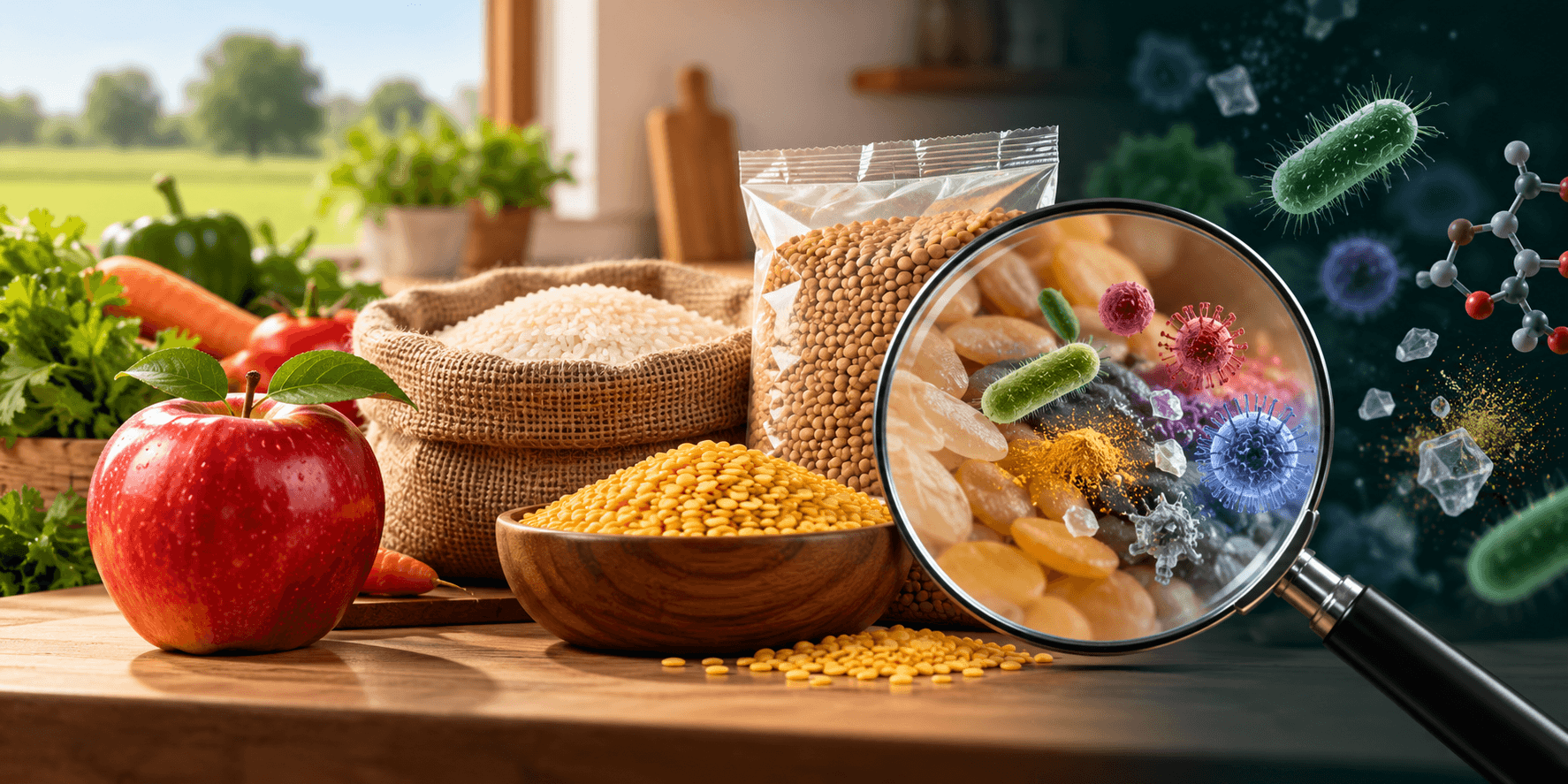
A shiny apple.
Bright yellow dal.
Fresh-looking rice.
Perfectly sealed packaging.
We often assume that if food looks good, it must be safe.
But food safety isn't always visible.
Some of the biggest food-safety concerns, including certain pesticide residues, microbial contamination, adulterants and chemical contaminants, cannot be identified simply by looking, smelling or tasting the food.
So what exactly are we missing?
Your Eyes Can Only Tell You So Much
Imagine buying a packet of dal.
The grains look clean. There are no insects. The colour looks normal. The packaging is intact.
You might naturally assume everything is fine.
But appearance alone cannot tell you whether the product has been tested for contaminants or whether it meets applicable food-safety standards.
The same applies to many fresh foods.
A vegetable can look perfectly fresh while still carrying residues that aren't visible to the naked eye.
Clean-looking food isn't necessarily tested food.
Some Contaminants Don't Change How Food Looks
Food contamination can happen in different ways.
Depending on the food and contaminant involved, it may include:
Microbial contamination
Certain chemical contaminants
Adulterants
Many of these don't necessarily produce an obvious change in colour, smell or texture.
That's why the traditional kitchen test of “Look at it, smell it and taste it” has limitations.
Your senses are useful, but they aren't a laboratory.
What About Adulteration?
Adulteration is another reason appearance can be misleading.
Some adulterants may visibly change a food's appearance, but others can be difficult to detect without proper testing.
A product can look completely normal while still requiring laboratory analysis to determine whether it meets the relevant standards.
This is particularly important because home tests found online often provide only limited information.
A simple kitchen test may sometimes indicate a possible problem, but it shouldn't be treated as proof that a food is completely safe.
Then How Do We Know Food Is Safe?
This is where the less visible side of food safety becomes important.
Food safety relies on several layers of checks, including:
Good agricultural and manufacturing practices
How food is grown, handled, processed and packed matters.
Regulatory standards
Food products need to meet applicable food-safety requirements and limits.
Certain contaminants and residues can only be identified through appropriate analytical testing.
Knowing where a product came from and being able to trace its journey can make investigations and quality control more effective.
In other words, food safety isn't just about what you can see.
It's also about the checks happening behind the scenes.
What Can You Check at Home?
That doesn't mean consumers are powerless.
There are several things you can check yourself:
Check the packaging
Look for damaged, leaking, swollen or improperly sealed packs.
Read the label
Check ingredients, dates, storage instructions and manufacturer information.
Store food correctly
Even safe food can become unsafe if it is stored improperly after purchase.
Wash fresh produce
Washing can help remove dirt and some surface contaminants from fruits and vegetables.
Don't rely on appearance alone
A perfect-looking product isn't proof of safety.
The Bigger Picture: Food Safety From Start to Finish
The food on your plate has already travelled through a long chain before you eat it.
Farm → Processing → Testing → Packaging → Transport → Retail → Kitchen
A problem at any stage can potentially affect food safety.
That's why food safety needs more than a final visual inspection.
At TrulySafe by FarMart, we believe consumers should have greater visibility into how their food is handled and checked, because confidence in food should come from evidence, not appearance alone.
The next time something looks perfectly clean and fresh, remember:
Looking safe and being tested for safety are two different things.