Is Organic Food Automatically Free From Pesticide Residues?
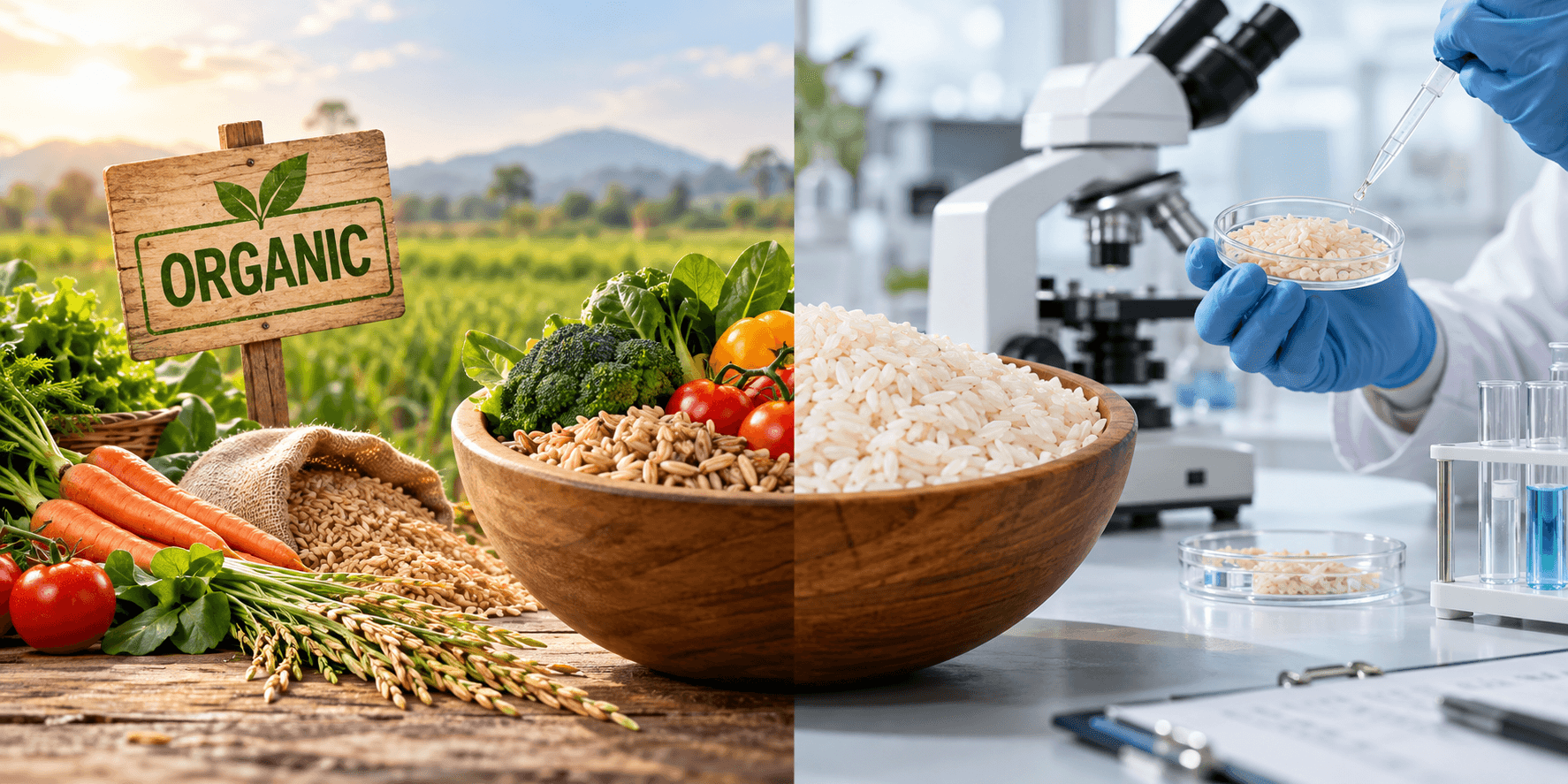
When you see the word “organic” on a food packet, you may assume it means the food is completely free from pesticides.
But is that actually true?
Not necessarily.
Organic farming follows specific standards that restrict or prohibit the use of many synthetic pesticides. However, organic food is not automatically the same as zero pesticide residues.
Does Organic Food Have Pesticides?
Organic farming does not mean that farmers never use pesticides.
Certain pesticides and crop-protection substances can be permitted under organic farming standards, depending on the crop, country and certification requirements.
There can also be other reasons why residues may be detected. Crops can be exposed to residues from surrounding farms, soil, water or accidental contamination during harvesting, transportation or storage.
So, “organic” and “pesticide-free” are not necessarily the same thing.
Does Organic Mean Safer?
Organic certification provides important information about how a food has been produced and whether it meets the relevant organic standards.
But food safety involves more than farming practices alone.
Factors such as pesticide residues, heavy metals, microbial contamination, storage conditions and adulteration can all matter.
This is why consumers should look beyond a single label when thinking about food safety.
How Can Pesticide Residues Be Detected?
You cannot reliably identify pesticide residues by looking at, smelling or tasting food.
Laboratory testing can detect specific pesticide residues, sometimes at very low concentrations.
This is important because a food can look completely normal while still requiring testing to verify what's actually present.
Organic vs Pesticide-Free: What's the Difference?
The terms are often used interchangeably, but they are not the same.
Organic generally refers to how a food is produced under defined standards.
Pesticide-free suggests the absence of pesticide residues, which is a much stronger claim and requires appropriate evidence and testing.
In other words, an organic label tells you something about the production system; testing tells you something about what was detected in the tested sample.
What Should Consumers Look For?
Instead of relying on a single claim, consider a more complete approach to food safety:
Know where your food comes from.
Look for transparent sourcing information.
Check relevant certifications and labels.
Look for evidence of food-safety testing.
Pay attention to storage and handling.
Choose brands that are transparent about their safety processes.
At TrulySafe by FarMart, our approach is based on the idea that food safety should go beyond appearances and labels.
Our 5 Gates of TrulySafe bring together multiple safety checks across the food journey, supported by extensive testing and traceability.
Because a food product shouldn't be judged only by how it looks, or by one word on its packet.
The Bottom Line
Organic food is not automatically the same as pesticide-free food.
Organic standards can restrict the use of many synthetic pesticides, but residues can still be detected for different reasons. The only way to know what is present in a tested sample is through appropriate testing.
So when choosing food, don't stop at the label.
Ask where it came from, how it was handled and how its safety was verified.
That's the thinking behind TrulySafe by FarMart, food safety from start to finish.